STYX
By Patrick McGinn-Hammer
Originally published in Thel, the literary journal of Hobart and William Smith Colleges
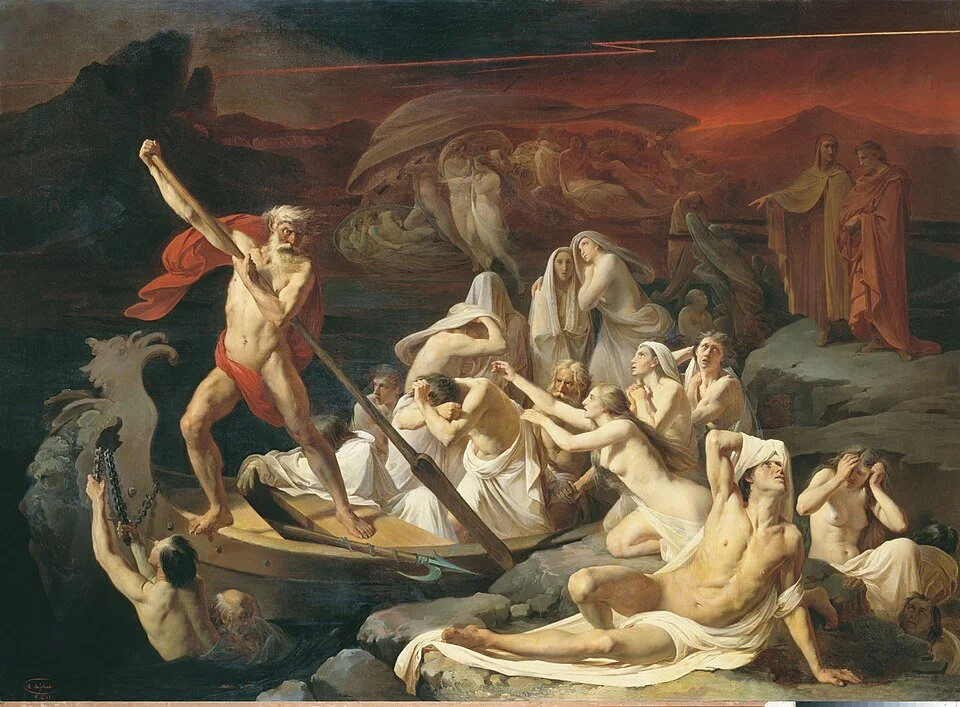
"Charon Carrying Souls Across the River Styx" by Alexander Dmitrievich Litovchenko, painted circa 1861
I watched ropes of water fall off my roof as I packed my things: jeans, two shirts, four socks, four boxers, and my sweatshirt that still smelled of her. I rolled the rest of my weed and added it to my bag alongside granola bars and an old photo from when our band was still together. Everything else—my glassware, the TV, the unpaid bills—I left behind.
I taped a note to my door, stating: Gone to STYX. Don’t wait.
I remember I first heard about Styx while reading Greek mythology in elementary school. It is the river of death that drags all souls through Hades’ lair, and those who swim against its current never make it through. Since my education, I next heard of it from Angela while we shared a smoke. She said she’d learned about it from her bus driver, and he from his banker. A river to freedom, that’s what she called it. Styx, an epithet for death. Looking back, I was too quiet during those most important moments.
Like on the last night, when she called from a number I didn’t recognize.
“Can you get me?” she asked. “I’m walking down Salina Street.”
I didn’t need any more details. I knew exactly where she was walking: the boathouse by the bus depot, the older guy at the backdoor, the folded twenties pressed into my hand, he said, “for gas.” I’d left her there without asking questions. I told myself she’d text if she needed anything.
When I found her, she was barefoot in the snow. She rubbed her feet, red from the cold. “I keep picking the wrong paths,” she said quietly, getting in the car. “Wrong questions. Wrong answers. I think the River may be the only honest guide; it pulls you without judgement of holiness or wit.”
“That’s not honesty,” I said. “Honesty has preference.”
“It is,” she said plainly. “People think running away is cowardice, but it takes guts to swim beyond your own life.”
We spent most of the ride in silence as we drove over the bridge and through downtown, past the bank adorned with goldleaf, past city hall and its giant wooden doors, past the Cathedral, lines of meltwater spilling from its gargoyles and vanishing under grates.
“You’re afraid of it,” she said.
“I’m afraid of a lot of things. Most of which is losing myself to something that isn’t real.”
“Styx is real,” she said. “It is as real as me, as anybody. In it is all that has been lost. It gives you yourself back.”
“What if I don’t want myself? What if I want you?”
She didn’t look at me. “You want a version of me. A version of me with no past. And she’s out there, swimming in the River.”
Suddenly she said, “Here!” And I couldn’t argue.
I pulled over near the edge of town. Empty fields, full of nothing but rivulets of melting snow. She opened the door and got out, her face, her palms, her feet still red as she walked into the woods. I watched until I lost sight of her in the darkness, and only the faint sound of running water remained.
